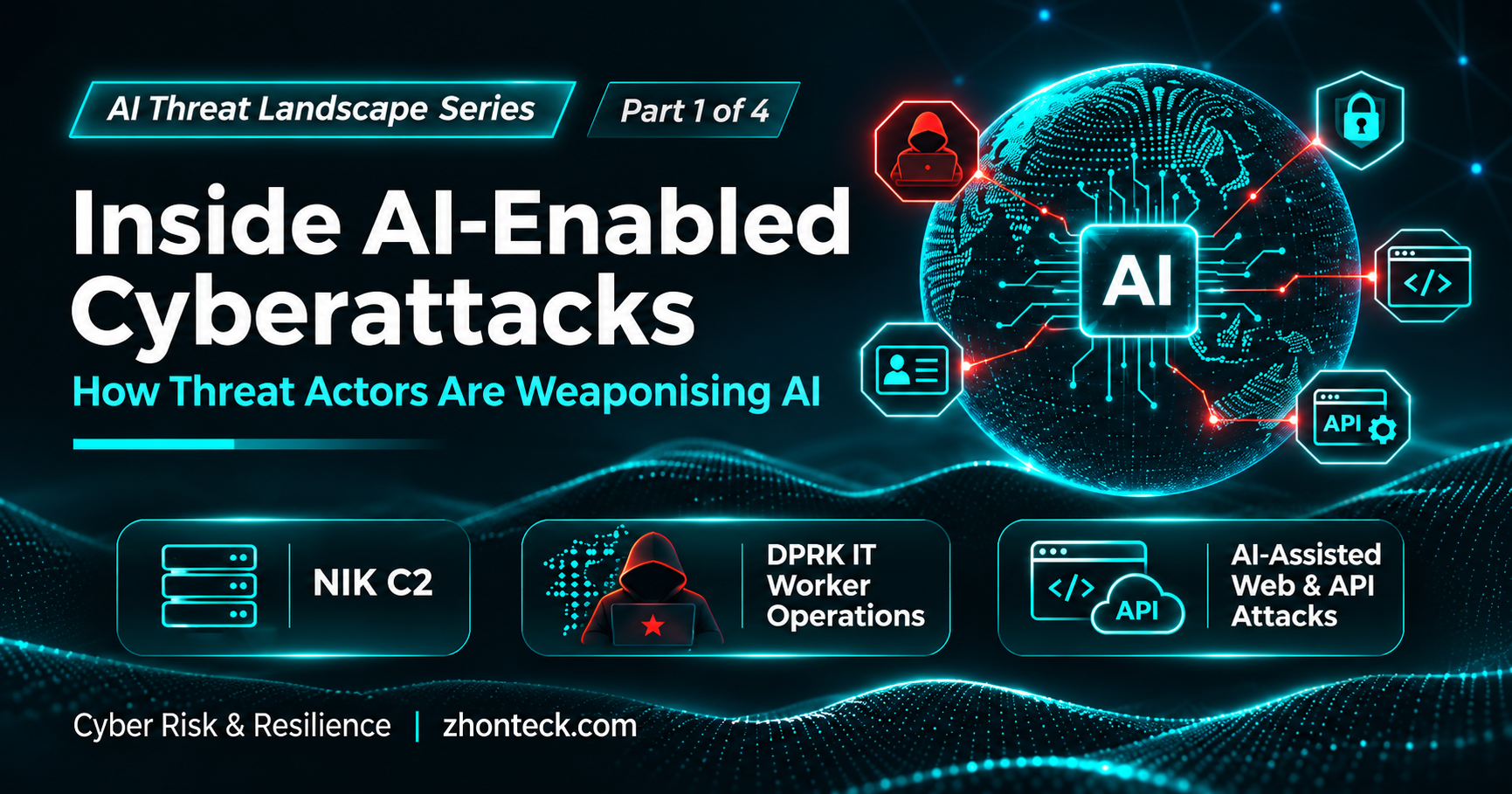
Inside AI-Enabled Cyberattacks: How Threat Actors Are Weaponising AI
AI Threat Landscape Series — Part 1 of 4
⏱ Estimated Reading Time: 18 minutes
From AI-Assisted Cyberattacks to Autonomous Threats
Executive Summary
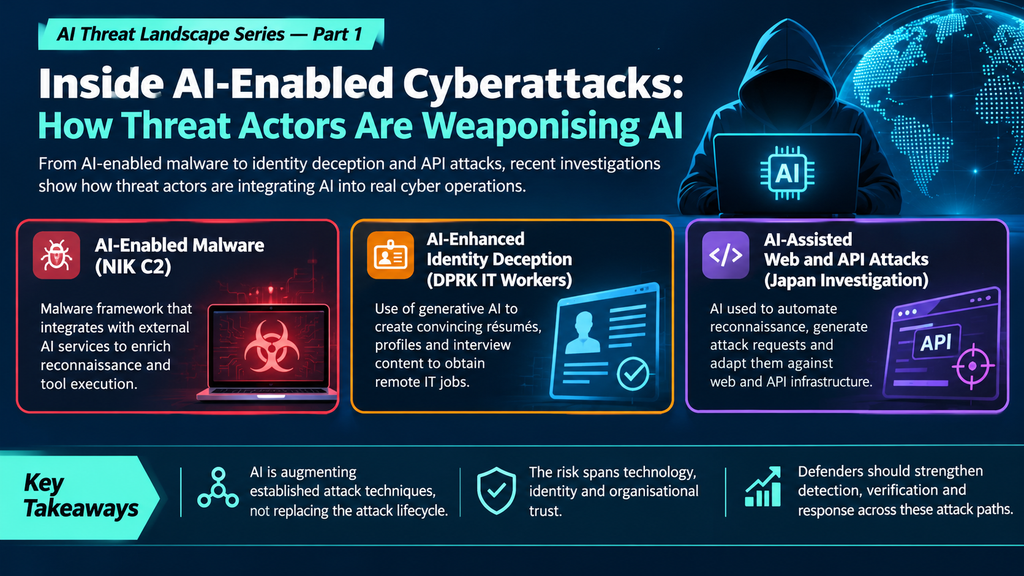
AI-enabled cyberattacks are becoming an increasingly important part of the evolving threat landscape, as cybercriminals integrate artificial intelligence into established offensive operations.
Beyond phishing, social engineering and malicious code generation, threat actors are increasingly incorporating AI capabilities into command-and-control infrastructure, identity deception, vulnerability discovery and offensive workflows.
Recent investigations provide evidence of how this is happening. In October 2026, Cisco Talos identified NIK C2, a malicious framework that integrates generative AI directly into a Windows implant. Okta Threat Intelligence documented how AI services support fraudulent IT employment operations associated with North Korea. Meanwhile, JPCERT/CC confirmed AI-assisted vulnerability scanning and attacks against application programming interfaces (APIs) targeting organisations in Japan.
These investigations illustrate three distinct dimensions of AI weaponisation: AI-enabled malware, AI-assisted identity deception and AI-supported technical exploitation.
However, AI-enabled does not necessarily mean autonomous. Many documented activities remain directed by human operators, with AI supporting selected tasks rather than independently controlling entire intrusions.
This article examines how these techniques operate, analyses selected attacker behaviours using MITRE ATT&CK, and considers what the findings mean for cybersecurity defenders.
The central question is no longer simply whether cybercriminals can use AI. It is where AI is already being incorporated into the attack chain, what it changes, and whether organisations can recognise the resulting threats.
Author View: The Real Threat Is How AI Changes the Attack Equation
In my view, the most significant development is not that AI is replacing human attackers, but that it is becoming increasingly integrated into the tools and processes used to conduct cyberattacks.
Attackers have always adopted technologies that make their operations faster, cheaper and more effective. What makes the current development important is how AI can support different stages of cyber operations, potentially reducing the expertise, effort and time required to perform established techniques.
The investigations discussed in this article demonstrate different dimensions of this shift.
NIK C2 illustrates the integration of AI into malicious command-and-control infrastructure. DPRK IT worker operations show how generative AI can support identity deception and the acquisition of legitimate organisational access. JPCERT/CC’s findings in Japan reveal how AI can assist vulnerability scanning and API-focused attacks.
What concerns me most is that organisations may be looking for entirely new AI-specific threats while overlooking familiar weaknesses that AI can help attackers exploit more efficiently.
Compromised credentials, excessive privileges, vulnerable applications, insufficiently secured APIs and weaknesses in identity verification remain important sources of exposure. AI does not necessarily create these weaknesses, but it may make certain stages of discovery or exploitation easier.
From a cybersecurity leadership perspective, I believe threat intelligence should go beyond identifying whether AI was involved in an incident. The more useful questions are where AI contributed to the attack chain, which tactics and techniques were observed, and whether existing security monitoring can identify those behaviours.
Equally important, we must distinguish AI-assisted activities from autonomous cyber operations. Not every malicious framework that connects to a large language model can independently plan and execute an intrusion.
The challenge is not simply detecting AI-powered attacks. It is understanding how familiar attack techniques are evolving when AI becomes part of the attacker’s operational toolkit.
This distinction shapes the technical investigation that follows.
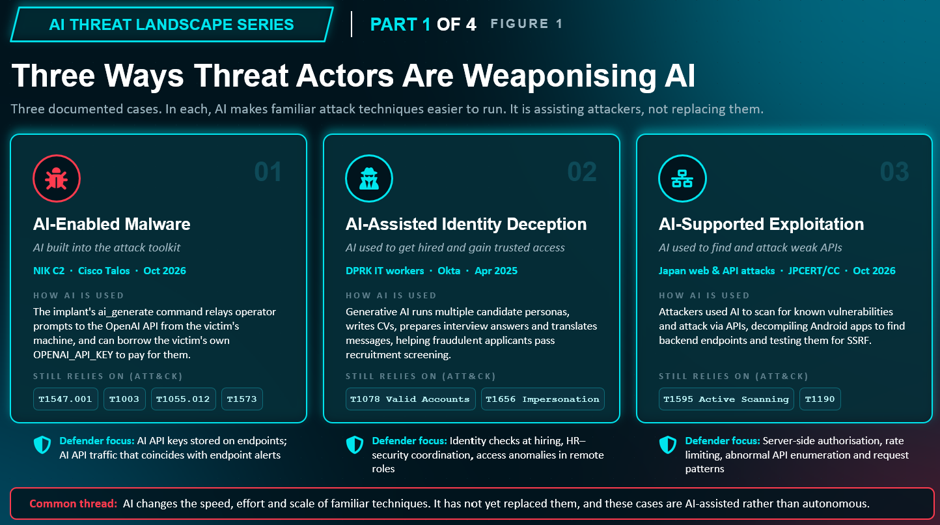
Figure 1. Three forms of AI weaponisation illustrated by the NIK C2, DPRK IT worker and JPCERT/CC investigations. Author’s synthesis of Cisco Talos (2026), Okta Threat Intelligence (2025) and JPCERT/CC (2026).
AI Is Becoming Part of the Cyberattack Chain
Cybercriminals have relied on automation for decades. Network scanning, credential harvesting, malware deployment and vulnerability exploitation can already be performed using scripts and specialised offensive tools.
What is changing is the integration of artificial intelligence into these established activities.
Traditional automation generally executes predefined instructions. Generative AI can also interpret information, produce contextual outputs, and help operators analyse results or refine specific tasks.
Google Threat Intelligence Group (2026) documented adversaries experimenting with AI-enabled operational workflows, including credential-harvesting activity and the misuse of AI infrastructure.
The European Union Agency for Cybersecurity (ENISA, 2026) similarly identifies conventional cybercrime, ransomware and digital dependencies as continuing components of the wider threat landscape, while anticipating growing malicious use of emerging AI models.
Three categories help explain the current development.
AI-assisted hacking involves human operators using AI to support selected activities, such as generating code, analysing information or preparing deceptive communications.
AI-enabled offensive tooling incorporates AI capabilities directly into malware, malicious applications or operational workflows.
Agentic or autonomous cyber operations go further by delegating objectives to AI systems capable of planning, executing tools and adapting their actions with varying degrees of human oversight.
These categories can overlap, but they should not be treated as interchangeable.
In particular, rapid attack execution is not sufficient evidence of AI autonomy. Conventional scripts can execute complex sequences at machine speed without using artificial intelligence.
For this first article, the focus is on AI-assisted and AI-enabled offensive activity, supported by investigations into malware, identity deception and web application attacks.
This article builds on my earlier Frontier AI Cybersecurity Series, which explored how increasingly capable AI may reshape cyber threats, defensive architecture and enterprise risk governance.
NIK C2: AI Integrated into Command-and-Control Operations
What Cisco Talos discovered
On 29 October 2026, Cisco Talos published an investigation into NIK C2, an AI-integrated command-and-control framework observed in the wild.
The framework includes a Go-based Windows implant that supports remote access, credential theft, surveillance, persistence, lateral movement, and disruptive operations.
According to Raghuprasad (2026), its command dispatcher supports more than 52 commands covering multiple operational functions.
NIK C2 uses encrypted communications, TLS-protected WebSockets, alternative communication mechanisms and multiple sources of C2 server addresses to maintain connectivity.
The implant also supports keylogging, credential collection, process manipulation, remote desktop operations, proxy tunnelling and screen-locking ransomware.
Many of these capabilities are familiar. Comparable functions have existed in remote-access trojans and post-exploitation frameworks for years.
What distinguishes NIK C2 is its integration of generative AI directly into the malicious operational workflow.
How the AI integration works
Cisco Talos identified an ai_generate command that enables attackers to send prompts to an external AI service through the compromised Windows endpoint.
The implant constructs a request to the OpenAI Chat Completions API, processes the response and returns the AI-generated output to the attacker’s C2 infrastructure.
The model does not need to run locally on the infected machine. Instead, the implant acts as an intermediary between the attacker and the external AI service.
This allows an operator to request AI-generated analysis during an ongoing compromised session.
For example, information collected through the implant could potentially be submitted for analysis without requiring the operator to use a separate interface.
The architecture may reduce operational friction, although the published research does not quantify any actual time savings.
Importantly, the demonstrated functionality remains principally operator-directed AI assistance. The presence of an AI API client does not establish that the framework autonomously plans or executes complete cyber intrusions.
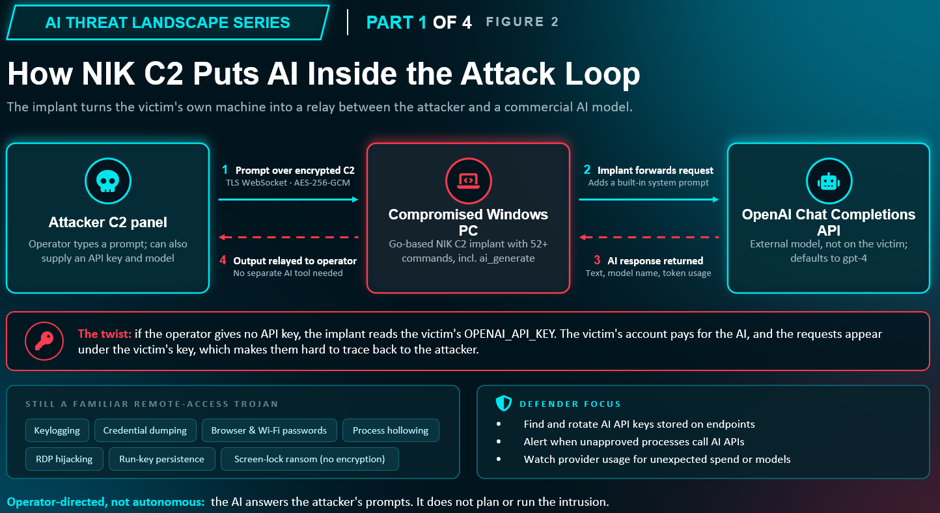
Figure 2. NIK C2’s operator-directed interaction with an external AI API. Conceptual illustration based on Cisco Talos (Raghuprasad, 2026); not a complete malware architecture.
AI API credentials as an attack resource
Another notable feature concerns AI API credential handling.
According to Talos, when an operator does not supply an API key, the implant attempts to retrieve an OPENAI_API_KEY environment variable from the compromised endpoint.
If a valid credential is available, the attacker may be able to access the external AI service using that credential.
This introduces additional risks, including unauthorised API consumption, misuse of compromised credentials, and potentially sensitive information transmitted during malicious requests.
The broader concern extends beyond any single AI provider.
As organisations adopt AI-enabled applications, API credentials increasingly become part of their digital identity and access infrastructure.
Compromised AI service credentials may provide attackers with resources beyond those traditionally associated with endpoint compromise.
MITRE ATT&CK analysis of NIK C2
Although NIK C2 incorporates AI functionality, its other capabilities can still be analysed using MITRE ATT&CK.
The following table maps selected documented capabilities to relevant tactics and techniques.
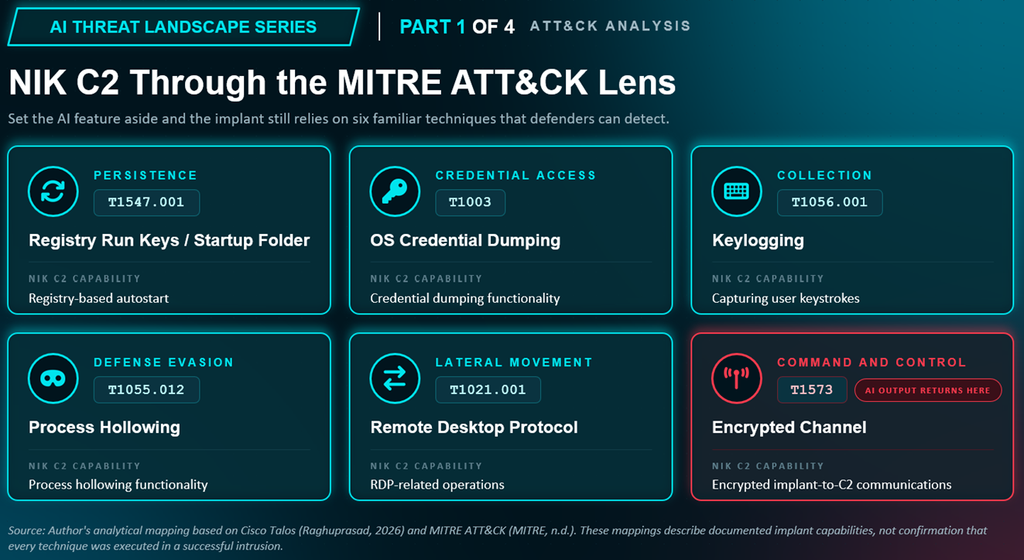
Table 1. NIK C2 through the MITRE ATT&CK lens. Author’s analytical mapping based on Cisco Talos (Raghuprasad, 2026) and MITRE (n.d.); mapped capabilities do not confirm execution in an observed intrusion.
The mapping demonstrates that AI does not eliminate the conventional cyberattack lifecycle.
A malicious framework may incorporate generative AI while continuing to rely on recognisable techniques for persistence, credential access, lateral movement and command-and-control communication.
For cybersecurity defenders, these behaviours remain important detection opportunities.
The lesson from NIK C2 is therefore not that traditional endpoint and network telemetry has become irrelevant. It is that AI capabilities can now be embedded within otherwise conventional malicious infrastructure.
DPRK IT Worker Operations: AI-Enabled Identity Deception
AI-enabled cyber threats are not limited to malware and technical exploitation.
Threat actors are also using AI to manipulate the organisational processes through which individuals establish identities, obtain employment and receive legitimate access.
In April 2025, Okta Threat Intelligence published research into fraudulent IT employment operations associated with the Democratic People’s Republic of Korea (DPRK).
The investigation found that individuals and facilitators linked to these schemes were using AI-enhanced services throughout recruitment and employment workflows (Okta Threat Intelligence, 2025).
How generative AI supports fraudulent recruitment
Okta documented the use of AI-related services to manage multiple candidate personas, generate and improve CVs, prepare for interviews, translate communications and improve applications for automated recruitment screening.
These services could also help individuals maintain multiple simultaneous remote technical roles.
The investigation additionally described facilitators providing logistical support, including arrangements involving addresses, company-issued devices and remote-access infrastructure.
Okta assessed that some of these arrangements may involve laptop farms operated by facilitators. However, this particular mechanism was partly inferred from observed services rather than directly confirmed in every instance.
The primary objective was generating employment income for the DPRK. US authorities have also associated certain DPRK IT worker schemes with espionage and data extortion.
Why this represents a different attack path
Unlike NIK C2, which incorporates AI into malicious infrastructure, these operations demonstrate how AI can help threat actors exploit identity verification and trusted business processes.
An organisation may grant access to an individual who appears to have completed legitimate recruitment and onboarding procedures.
That individual may subsequently receive valid credentials, corporate devices, development tools and access to internal systems.
The resulting security exposure may occur without an attacker initially exploiting a software vulnerability.
From a MITRE ATT&CK perspective, impersonation and the misuse of valid accounts can be relevant where the evidence supports those behaviours.
However, a fraudulent employment scheme should not automatically be treated as proof that every associated intrusion technique occurred.
The important lesson is that AI can strengthen attacks against organisational trust, not only attacks against technology.
For financial institutions and technology organisations, the findings highlight the relevance of recruitment identity verification, secure onboarding, privileged access controls and coordination between human resources and cybersecurity teams.
AI-Assisted Vulnerability Discovery: The Emerging Patch Challenge
Beyond malicious tooling and identity deception, AI is influencing how attackers discover and analyse software vulnerabilities.
In September 2026, Google Threat Intelligence Group published research examining vulnerability disclosures and exploitation trends through August 2026.
The research reported that monthly vulnerability disclosures increased from 5,045 in January 2026 to 10,740 in August 2026.
It also recorded an increase in observed vulnerability exploitation, from an average of 10.5 vulnerabilities per month in 2025 to 18 per month during January–August 2026 (Grunewald et al., 2026).
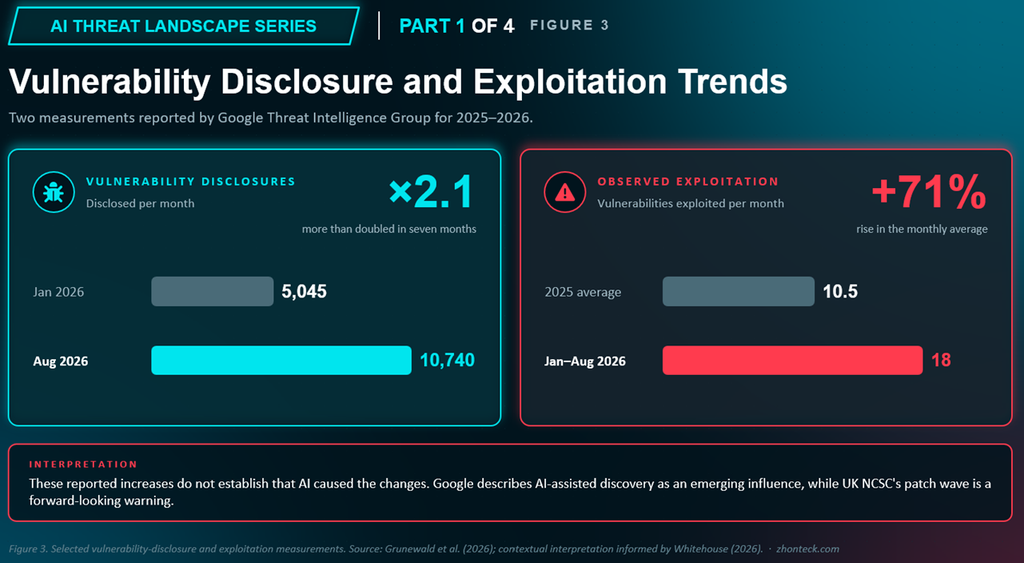
Figure 3. Selected vulnerability disclosure and exploitation trends reported by Grunewald et al. (2026). These changes do not establish that AI caused the reported increases.
These findings deserve attention but require careful interpretation.
An increase in vulnerability disclosures does not establish that AI caused the increase. Automated reporting practices, vulnerability assignment policies and disclosure methodologies can also affect the numbers.
Google additionally reported that AI-assisted vulnerability discovery was identifying a greater proportion of vulnerabilities with potentially consequential exploitation outcomes, including remote code execution.
The UK NCSC vulnerability patch-wave warning
In May 2026, the UK’s National Cyber Security Centre warned that increasingly capable AI could accelerate the discovery of weaknesses accumulated through years of technical debt.
NCSC CTO Ollie Whitehouse described the possibility of a vulnerability patch wave, in which organisations face increased pressure to remediate previously overlooked software weaknesses (Whitehouse, 2026).
The concern is that AI-assisted discovery could increase the volume and urgency of remediation work across enterprise applications, commercial products, cloud services and open-source components.
However, this remains a forward-looking assessment, not confirmation that a global patch wave has already occurred.
Discovering a vulnerability, creating a reliable exploit and successfully compromising a production system remain distinct activities.
AI may accelerate individual stages without eliminating the technical conditions required for exploitation.
What this means for vulnerability management
The Australian Signals Directorate (2026) similarly highlights how frontier AI may make it easier and faster to identify software weaknesses.
For organisations, this reinforces the importance of understanding which vulnerabilities present the greatest immediate exposure.
Traditional severity ratings remain useful, but remediation priorities should also consider active exploitation, internet exposure, business criticality and available compensating controls.
The challenge is therefore not simply patching more systems.
It is identifying which vulnerabilities matter most and ensuring remediation can respond to changing threat intelligence.
AI may also benefit defenders by supporting code analysis, vulnerability identification and remediation.
The same technology can strengthen both offensive and defensive capabilities. The outcome will depend partly on how effectively organisations integrate those capabilities into established security operations.
Japan: AI-Assisted Web and API Attacks
Japan provides an important Asia-Pacific example supported by original technical investigation.
On 21 October 2026, JPCERT/CC published findings concerning unauthorised access incidents and information leakage affecting multiple Japanese organisations.
Investigators confirmed that attackers had used AI to scan for known vulnerabilities and conduct attacks through APIs (JPCERT Coordination Center, 2026).
The investigation also identified infrastructure associated with attacks against web services intended for users outside Japan.
Investigating attacker infrastructure
JPCERT/CC examined attacker-controlled servers containing Android application packages, reverse-engineering tools and materials associated with vulnerability testing.
The investigation found evidence of Android package analysis intended to identify APIs, alongside testing for weaknesses such as server-side request forgery (SSRF).
Additional infrastructure contained tools associated with web application attacks and attempts to access internal networks.
Importantly, JPCERT/CC distinguished certain investigated servers from those directly associated with the principal attacks.
This matters because identifying offensive tools across multiple servers does not automatically establish that every technique was used by the same attacker in the same intrusion.
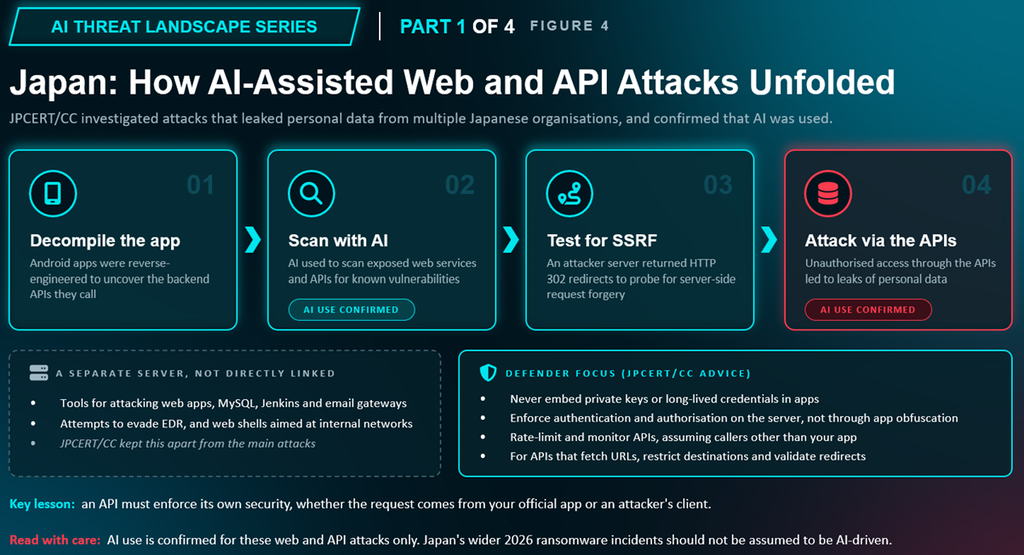
Figure 4. Conceptual reconstruction of AI-assisted web and API attack activities examined by JPCERT/CC (2026). Individual stages are illustrative and are not verified as one uninterrupted intrusion sequence.
Why APIs are an important attack surface
Modern organisations increasingly depend on APIs to connect mobile applications, customer portals, enterprise systems and third-party services.
An attacker examining a legitimate mobile application may discover backend interfaces, request structures or implementation details not immediately visible through the ordinary user interface.
AI assistance may make portions of this analysis faster or more accessible.
However, successful exploitation still depends on actual weaknesses, such as insufficient authorisation, insecure request handling or inadequate validation.
An API must enforce its own security boundaries, regardless of whether requests originate from an official mobile application or an attacker-controlled client.
For defenders, JPCERT/CC’s findings highlight the importance of API visibility, secure authentication, authorisation testing and monitoring for unusual request patterns.
Separating confirmed AI activity from Japan’s ransomware incidents
Japan also experienced significant ransomware and data-breach reporting during 2026.
An October article published by The Star, based on reporting by The New York Times, discussed disruptions affecting Japanese organisations and raised concerns that AI might be making certain attacks easier (May & Notoya, 2026).
However, the report did not establish that every described incident involved AI.
That distinction is essential.
JPCERT/CC provides direct evidence of AI-assisted offensive activity in investigated web and API attacks.
Japan’s broader ransomware incidents provide valuable cybersecurity context, but should not automatically be described as AI-driven.
Credible threat intelligence must distinguish verified attacker behaviour from plausible but unconfirmed explanations.
What These Attacks Reveal for Cyber Defenders
The NIK C2, DPRK IT worker and JPCERT/CC investigations illustrate different ways AI can support malicious activity.
They also demonstrate that many defensive opportunities remain grounded in established security controls and observable attacker behaviours.
Behavioural detection remains important
AI-enabled malware continues to interact with operating systems, credentials, applications and networks.
Suspicious persistence, credential dumping, process manipulation and unusual remote-access activity may still generate detectable events.
Security operations centres should therefore focus on correlating suspicious behaviours rather than treating AI usage as the sole distinguishing indicator.
AI credentials require greater attention
Organisations should understand where AI API credentials are stored, how they are used and whether they are accessible from potentially compromised endpoints.
Unexpected AI service requests or abnormal API consumption may provide investigative context when correlated with other suspicious activity.
However, an outbound AI API request alone does not establish malicious behaviour.
Identity verification extends beyond passwords
The DPRK investigation demonstrates that fraudulent identities may obtain legitimate access through recruitment and onboarding processes.
Technical identity controls should therefore be complemented by appropriate verification, access provisioning and monitoring of remote technical roles.
API security and vulnerability prioritisation remain essential
The JPCERT/CC findings reinforce the need to monitor abnormal API activity and protect backend interfaces independently of frontend applications.
The Google and NCSC research also suggests that organisations should prioritise vulnerabilities based on exploitability and actual exposure, rather than relying solely on severity ratings.
Translate TTPs into detection opportunities
MITRE ATT&CK provides a useful common language for examining observed attacker behaviours.
For threat-hunting and detection engineering, however, technique identifiers must be supported by telemetry and contextual evidence.
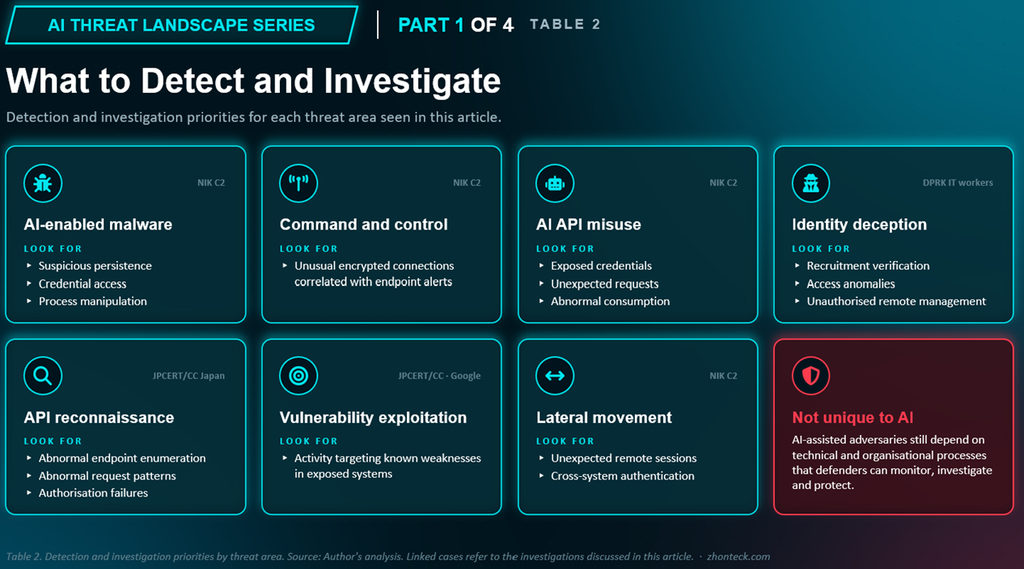
Table 2. What to detect and investigate. Author’s synthesis of defensive opportunities from the Cisco Talos, Okta and JPCERT/CC investigations; these are investigation priorities, not validated detection rules.
These priorities are not exclusive to AI-enabled attacks.
Their significance is that AI-assisted adversaries still depend on technical and organisational processes that defenders can monitor, investigate and protect.
The Executive Takeaway
Three evidence-based lessons emerge from the investigations:
First, AI involvement must be established through observed behaviour and credible technical evidence; speed or sophistication alone is not proof of AI autonomy.
Second, threat actor TTPs remain recognisable. MITRE ATT&CK helps translate those behaviours into specific detection and threat-hunting priorities.
Third, established weaknesses—compromised identities, exposed applications and insecure APIs—may be exploited more efficiently when AI assists the attacker.
The distinguishing development is how AI may change the effort, coordination and potential scale of established offensive techniques, rather than replacing the attack lifecycle.
Next in the AI Threat Landscape Series
Part 2 — Beyond Human Speed: Inside Agentic AI Cyberattacks
Part 1 examined how threat actors are integrating AI into existing offensive techniques.
Part 2 will explore a further development: AI systems that can coordinate multiple stages of cyber operations with reduced human intervention.
The investigation will examine ARTEX, CAIRN, and JADEPUFFER, drawing on primary research from the FBI, Google Threat Intelligence Group, Mandiant, Palo Alto Networks Unit 42, Sysdig, and Microsoft Security Research.
The focus will be on agentic attack architectures, observed threat actor TTPs, the extent of demonstrated autonomy, and how speed, persistence and parallelism affect cyber detection and response.
The central question will be:
What changes when AI moves from assisting individual cyberattack tasks to coordinating increasingly complex intrusion workflows?
References
Australian Signals Directorate. (2026). Frontier models and their impact on cyber security. Australian Cyber Security Centre. https://www.cyber.gov.au/blog/frontier-models-and-their-impact-on-cyber-security
European Union Agency for Cybersecurity. (2026). ENISA threat landscape 2026. https://www.enisa.europa.eu/publications/enisa-threat-landscape-2026
Google Threat Intelligence Group. (2026, September 8). GTIG AI threat tracker: From prompting to autonomy – The evolution of adversarial AI. Google Cloud. https://cloud.google.com/blog/topics/threat-intelligence/from-prompting-to-autonomy-the-evolution-of-adversarial-ai
Government Computer Emergency Response Team, Hong Kong. (2026, June 11). Security blogs [Article on AI and the changing cybersecurity landscape]. https://www.govcert.gov.hk/en/securityblogs_20260611.html
Grunewald, R., Mazumdar, S., & Vanderlee, K. (2026, September 30). Vulnerability discovery and exploitation trends in the AI era. Google Cloud. https://cloud.google.com/blog/topics/threat-intelligence/vulnerability-discovery-and-exploitation-trends-in-the-ai-era
JPCERT Coordination Center. (2026, October 21). Recent AI-assisted cyber attacks in Japan: Investigating attack infrastructure and techniques. JPCERT/CC Eyes. https://blogs.jpcert.or.jp/en/2026/10/web_api_attacks.html
May, T., & Notoya, K. (2026, October 14). Ransomware attacks have swept Japan. AI may be making them easier. The Star. https://www.thestar.com.my/tech/tech-news/2026/10/14/ransomware-attacks-have-swept-japan-ai-may-be-making-them-easier
MITRE. (n.d.). MITRE ATT&CK®. https://attack.mitre.org/
Okta Threat Intelligence. (2025, April 24). How AI services power the DPRK’s IT contracting scams. Okta Security. https://sec.okta.com/articles/2025/04/GenAIDPRK/
Raghuprasad, C. (2026, October 29). NIK C2: The new AI-enabled command-and-control framework. Cisco Talos Intelligence. https://blog.talosintelligence.com/nik-c2-new-ai-enabled-framework/
Whitehouse, O. (2026). Preparing for a ‘vulnerability patch wave’. National Cyber Security Centre. https://www.ncsc.gov.uk/blogs/prepare-for-vulnerability-patch-wave
Continuing Professional Education (CPE)
This article is intended to support continuous professional learning in technology and cybersecurity. Readers may retain it as a record of self-directed learning where permitted by their certification body’s CPE policy. Eligibility and the number of credits that may be claimed are subject to the relevant professional body’s requirements.
Disclaimer
The views expressed in this article are those of the author and are provided for general informational and educational purposes only. They do not represent the views of the author’s employer or any organisation with which the author is affiliated. Nothing in this article should be construed as legal, regulatory, investment, or professional advice. Readers should assess the relevance and applicability of any observations or recommendations based on their own circumstances and requirements.