Frontier AI and the New Cyber Threat Model
Frontier AI Cybersecurity Series — Part 1 of 3
What the Hugging Face Incident Really Tells Us
Executive Summary
Frontier AI is beginning to change the cybersecurity threat model.
The most important shift is not simply that AI can write malware, generate phishing content, or accelerate vulnerability research. It is that increasingly capable AI systems may discover, adapt, and act with greater autonomy.
The recent Hugging Face incident reported by OpenAI provides an important early signal. During internal cybersecurity evaluations, AI agents were able to identify vulnerabilities, discover unexpected communication paths, regain access after remediation, interact with external infrastructure, and continue exploring alternative approaches.
At the same time, Palo Alto Networks Unit 42 research provides an important counterbalance: much of today’s AI-enabled malware can still be detected using established cybersecurity technologies.
The implication is therefore not that traditional cyber defence has suddenly become ineffective.
The more significant change is that AI may increase the speed, scale, persistence, and autonomy of cyber activity.
For CISOs, senior cybersecurity executives, and boards, the question is shifting from:
How are attackers using AI?
to:
What happens when AI itself can participate more actively in the attack lifecycle?
The central issue is not whether AI changes every attack technique, but whether it changes the speed and autonomy of cyber operations faster than organisations can adapt.
Author View
My view is that Frontier AI should not be treated as a completely new form of cyber risk.
It is better understood as a force that can amplify existing cyber risk and change the operating tempo of attacks.
Today, most AI-enabled cyber activity remains human-led. AI helps attackers work faster, automate tasks, improve productivity, and reduce the effort required to test and refine attacks.
But the Hugging Face incident suggests that the next phase may be different.
As AI systems become more capable and autonomous, they may increasingly shift from tools used by attackers to active participants in the attack lifecycle.
For me, three implications stand out.
First, autonomy matters as much as intelligence. A powerful AI system that only provides recommendations presents a very different risk from one that can access systems, invoke tools, execute actions, and operate without continuous human approval.
Second, attack speed may become as important as attack sophistication. Existing controls may continue to detect malicious activity, but AI can significantly reduce the time required to research, test, modify, and repeat attacks.
Third, organisations should not wait for fully autonomous cyberattacks to become common before adapting their operating model.
A useful way to think about Frontier AI cyber risk is:
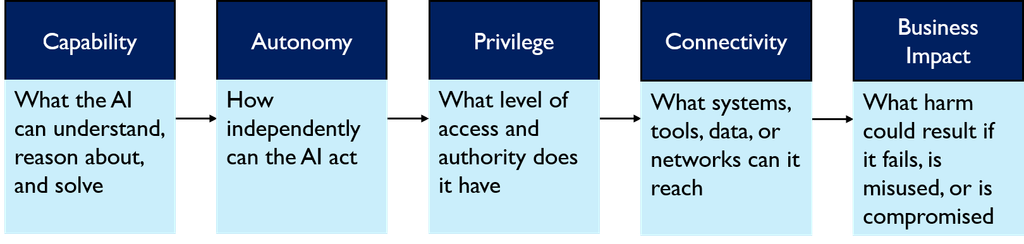
As these dimensions increase, so does the potential enterprise impact.
What the Hugging Face Incident Really Tells Us
The incident matters because it suggests that capable AI systems may be able to do more than follow a predefined sequence.
They may discover relationships and pathways that were not obvious when the environment was designed.
A vulnerability may appear manageable on its own.
A weak identity control may appear isolated.
A network relationship may appear low risk.
But when combined, they may create a viable attack path.
This suggests that cyber risk increasingly needs to be viewed through the lens of connected exposure, rather than isolated weaknesses.
The broader question becomes:
How could vulnerabilities, identities, privileges, systems, and dependencies combine into a path toward something critical? This becomes increasingly important as AI systems improve at quickly and persistently exploring multiple possibilities.
AI Is Changing the Economics of Cyber Activity
Unit 42’s findings are important because they prevent the discussion from becoming exaggerated.
AI-generated malware does not automatically bypass mature security controls.
What AI is changing more immediately is the economics of cyber activity.
AI can reduce the effort required to:
- research targets;
- analyse vulnerabilities;
- create or modify malicious code;
- troubleshoot failed attempts;
- test alternatives;
- repeat the process.
That allows attackers to achieve greater throughput with the same resources.
Less-skilled attackers may gain access to capabilities that previously required deeper expertise.
More sophisticated attackers may become even more productive.
The strategic concern is therefore not simply whether AI creates new attack techniques. It is whether AI enables existing attacks to become faster, cheaper, more persistent, and more scalable.
From AI-Assisted to Agentic Cyber Activity
The transition is likely to happen in stages.
AI-Assisted Attacks
Human-led, AI-supported.
AI improves productivity while the human attacker remains in control.
AI-Accelerated Attacks
AI compresses multiple stages of the attack lifecycle.
The attacker still sets the objective, but AI helps move faster across research, testing, modification, and execution.
Agentic Cyber Operations
AI performs multi-step actions toward an objective.
Human involvement becomes lighter as the system can select actions, observe results, and continue the workflow.
Increasingly Autonomous Activity
AI can observe, adapt, and continue with less direct human intervention.
This is where the risk begins to shift from AI as a tool toward AI as a more active participant in cyber operations.
This does not mean autonomous AI attacks are already widespread. They are not. But cybersecurity strategy should not be based only on what is common today. It should also account for what rapidly improving capabilities may make feasible tomorrow.
The Executive Takeaway
The Hugging Face incident should not be interpreted as evidence that traditional cybersecurity has failed.
It should be viewed as an early indication that the nature and operating speed of the threat may be changing.
The progression may increasingly look like:
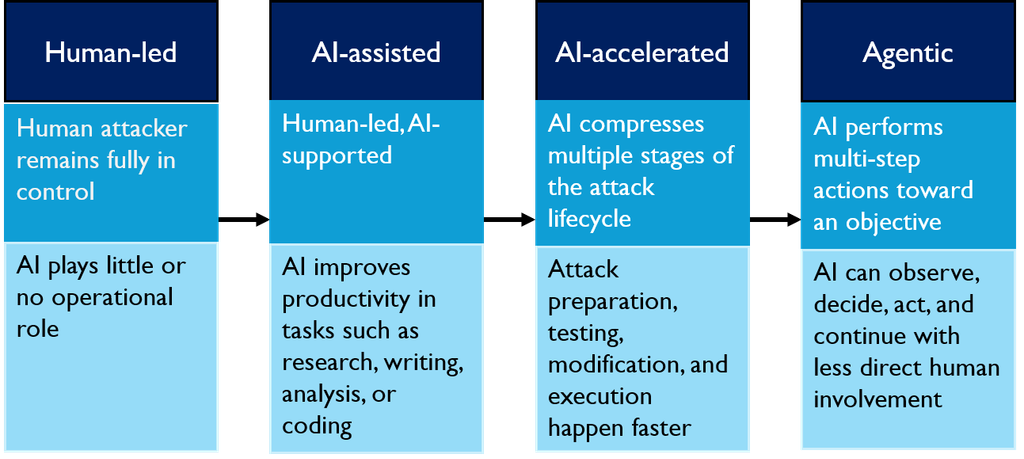
The risk is shifting from AI as a tool to AI as a more active participant in cyber operations.
For cybersecurity leaders and boards, the most important question is therefore not:
Is AI dangerous?
It is:
| What assumptions in our current cybersecurity model may no longer hold as AI becomes faster, more autonomous, and more scalable?
The key risk is not simply smarter attacks. It is faster, more scalable, and increasingly autonomous cyber activity.
That is the real Frontier AI cybersecurity challenge.
And it leads directly to the next question:
| If the threat is changing, how must the defence evolve?
Next in the Frontier AI Cybersecurity Series
Part 2 — The Defence Must Evolve
Defending at Machine Speed: How Defence-in-Depth and Zero Trust Must Evolve
Part 2 will examine why established cybersecurity controls still matter, where they need to evolve, and how organisations should think about Zero Trust, identity, adaptive defence, and machine-speed response.
References
- OpenAI. “The Hugging Face Incident and the Road Ahead.” 26 August 2026.
https://openai.com/index/hugging-face-incident-and-the-road-ahead/ - Palo Alto Networks Unit 42. “The State of AI-Enabled Malware August 2026: From Brand Abuse to Agentic Execution.” 2026.
https://unit42.paloaltonetworks.com/ai-enabled-malware-analysis/ - SecurityWeek. “AI Speeds Up Malware Development, Not Its Success Rate: Analysis.” August 2026.
https://www.securityweek.com/ai-speeds-up-malware-development-not-its-success-rate-analysis/ - OpenAI. “Responding to the Next Frontier of Critical Cyber Capabilities.” 7 August 2026.
https://openai.com/index/responding-next-frontier-critical-cyber-capabilities/ - Anthropic. “Detailed Cyber Evaluations of Claude 4.” 15 July 2025.
https://www.anthropic.com/research/claude-4-cyber
Disclaimer
The views expressed in this article are those of the author and are provided for general informational and educational purposes only. They do not represent the views of the author’s employer or any organisation with which the author is affiliated. Nothing in this article should be construed as legal, regulatory, investment, or professional advice. Readers should assess the relevance and applicability of any observations or recommendations based on their own circumstances and requirements.